
Few names carry the same instant recognition across generations and continents as Pelé. Born in poverty and raised on the streets of Bauru with nothing but a sock stuffed with rags for a ball, he became the most recognized face in world soccer and the only player to win three World Cup titles. His story is one of humble origins turning into global myth — a journey that reshaped how the world understands the beautiful game.
Biography Table
| Field | Details |
|---|---|
| Full Name | Edson Arantes do Nascimento |
| Nickname/Stage Name | Pelé (also called Dico by family and close friends) |
| Date of Birth | October 23, 1940 |
| Place of Birth | Três Corações, Minas Gerais, Brazil |
| Date of Death | December 29, 2022 |
| Age | 82 |
| Nationality | Brazilian |
| Profession/Occupation | Professional Footballer, Businessman, Politician |
| Years Active | 1956–1977 |
| Spouse/Partner | Rosemeri dos Reis Cholbi, Assíria Lemos Seixas, Márcia Aoki (respective marriages) |
| Children | Multiple, including Kely Nascimento |
| Parents | Dondinho (João Ramos do Nascimento), Dona Celeste |
| Notable Works | 1958, 1962, 1970 World Cup titles; New York Cosmos NASL title, 1977 |
| Awards/Honors | FIFA Player of the Century (2000), IOC Athlete of the Century, honorary knighthood from Queen Elizabeth II, UNESCO Goodwill Ambassador |
Early Life and Humble Beginnings in Bauru
Pelé was born Edson Arantes do Nascimento, named after Thomas Edison, and his parents later said the light had arrived in their family. He grew up poor, first in Três Corações and then in Bauru, where his father Dondinho struggled to make a living as a professional player. The family couldn’t afford a real ball, so young Edson played barefoot in the streets with a sock stuffed with rags.
His mother, Dona Celeste, actively discouraged him from pursuing football, wary of the financial instability that had defined his father’s career. Despite that, the boy’s talent was impossible to ignore. He played on amateur teams like Sete de Setembro and Ameriquinha before catching the attention of coach Waldemar de Brito, who saw something far beyond his years.
By age 14, de Brito had identified him as a rare talent, and by 15 he had joined the Bauru Athletic Club juniors. This period, marked by poverty and barefoot street games, became the foundation of a playing style built on instinct, balance, and creativity rather than formal training.
How Pelé Got His Name
The nickname “Pelé” has no defined meaning in Portuguese, and its origin has been debated for decades. The most widely accepted theory traces back to his childhood, when he mispronounced the name of a goalkeeper he admired, Bilé, and it stuck as a taunt among classmates. He reportedly disliked the name at first, thinking it sounded like an insult.
Pelé himself never gave a definitive account of the story. In a 2006 interview, he admitted he was unsure of the true origin, though he leaned toward the Bilé mispronunciation theory as the most likely explanation. He was, by contrast, genuinely proud of his birth name, Edson, given in honor of Thomas Edison.
Interestingly, more than six decades after it first appeared as a schoolyard mockery, “Pelé” became a word in its own right. In April 2023, Brazil’s Michaelis dictionary formally added Pelé as an adjective, following a 125,000-signature campaign. The entry allows usage like “He is the Pelé of basketball,” meaning exceptional or unequaled in any field, not just football.
Rise Through Santos: Early Career
Pelé signed with Santos in June 1956 at just 15 years old, a move made possible through his father’s connection to Santos president Athiê Jorge Coury via coach Waldemar de Brito. He scored in his professional debut within three months of joining and, before turning 16, had already led the league in goals during his first full season.
Over nearly two decades with the club, Pelé racked up an extraordinary 618 goals in 636 games by some counts, though total figures vary depending on which competitions are included. His performances quickly earned him a call-up to the Brazil national team just ten months after signing with Santos, setting the stage for the breakout moment that would define his legend.
Santos itself transformed into a global footballing institution during Pelé’s tenure. The club became world champions after beating Benfica in 1962 and Milan in the 1963 Intercontinental Cup, and it embarked on a grueling international touring schedule of over 100 games a year, with Pelé serving as Brazil’s greatest football ambassador on the road.
The 1958 World Cup: A Star Is Born
Pelé missed Brazil’s first two group matches at the 1958 World Cup in Sweden due to a knee injury, and the team psychologist reportedly argued against playing him. Coach Vicente Feola played him anyway in the third group match against the USSR, where he helped set up a goal and began restoring the confidence the coaching staff needed in him.
He scored his first World Cup goal in the quarterfinal against Wales, the only goal of a 1-0 win, at just 17 years old. In the semifinal against France on June 24, 1958, he produced a natural hat-trick built on instinctive volleys and a bouncing ball, sealing a 5-2 win.
In the final against host nation Sweden, Brazil won 5-2, with Pelé scoring twice more. At 17 years and 239 days old, he became the youngest player ever to score in a World Cup, the youngest to score a hat-trick, and the youngest to score in a final — records that still stand more than six decades later. The victory launched him from a promising teenager into a household name almost overnight, and the Brazilian government soon declared him a national treasure to block European transfer offers.
Injuries and Setbacks: 1962 and 1966 World Cups
The 1962 World Cup in Chile brought a bittersweet chapter. Pelé aggravated a groin injury against Czechoslovakia just two games into the tournament and was forced to sit out the rest of the competition, including the final. Brazil still won its second straight title without him on the pitch, a testament to the squad’s depth even in his absence.
The 1966 World Cup in England was, in Pelé’s own words, one of the worst years of his career. The Brazilian team was in transition, disagreements plagued the technical staff, and Pelé was targeted by brutal defensive tackles from Bulgarian, Portuguese, and other opposing defenders, with no substitutes allowed under the rules at the time.
The injuries forced him out of the tournament, and Brazil was eliminated after the first round — a stark drop-off that illustrated just how much the team depended on him. Pelé was reportedly disillusioned afterward and considered not playing in another World Cup, a decision that would have denied the world one of the greatest individual triumphs in the sport’s history.
The 1970 World Cup: Pelé’s Peak
Pelé was ultimately persuaded to play one more tournament, and 1970 became the peak of his career. Brazil’s squad that year is still regarded by many as the greatest team in World Cup history, and Pelé scored four goals across the tournament, including a rehearsed team move that set up Carlos Alberto’s iconic final-winning goal against Italy.
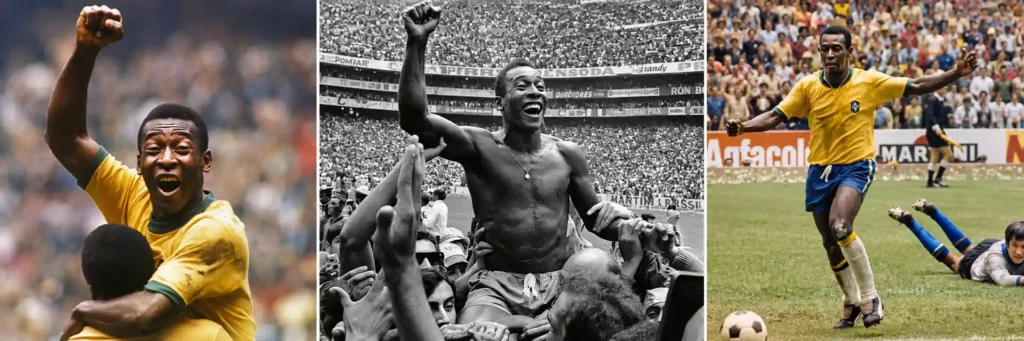
Brazil beat Italy 4-1 in the final, giving Pelé his third World Cup title and making him the only player in history to win three World Cups. He earned the tournament’s Golden Ball, and the win was followed by an emotional post-match ritual of swapping shirts with opposing players, including England’s Bobby Moore, whom Pelé regarded as one of the best defenders he ever faced.
A Symbol Beyond the Pitch: The Nigerian Ceasefire
Pelé’s fame extended well beyond football statistics. In the late 1960s, during the Nigerian Civil War, two warring factions reportedly agreed to a 48-hour ceasefire so that both sides could watch Pelé play an exhibition match in Lagos and Benin City in 1969. According to Santos club historian Guglierme Guarce, the moment turned Pelé into a world symbol of peace, illustrating a level of global influence that few athletes before or since have matched.
New York Cosmos and the Growth of American Soccer
In 1975, Pelé chose to join the New York Cosmos of the NASL, turning down lucrative offers from European giants like Real Madrid, Barcelona, and Inter Milan. His reasoning included wanting his children to learn English and the appeal of studying sports marketing in the United States, alongside the league’s shorter, five-month season.
He played for the Cosmos from 1975 to 1977, splitting time with a farewell exhibition between Cosmos and Santos, and helped lead the club to the 1977 NASL title in his final season as an all-star across all three of his Cosmos campaigns. Before his last match, he told the crowd, “Love is more important than what we can take in life.”
While joining the Cosmos represented a significant step down competitively from Europe’s top leagues, it dramatically boosted ticket sales and introduced soccer to a much wider American public, planting seeds for the sport’s growth in the U.S. decades before it became mainstream.
Pelé’s Goal-Scoring Records and Career Statistics
Pelé’s career numbers are legendary but disputed, largely due to inconsistent record-keeping across the 1950s through 1970s. What is undisputed is his international tally: 77 goals in 92 caps for Brazil, a record he shares with Neymar, including 12 goals in 14 World Cup matches, the second-most by any Brazilian in tournament history.
At club level, the picture gets more complicated. Most statisticians cite around 757 to 778 official goals across roughly 846 games. Guinness World Records lists a combined total of 1,281 goals in 1,363 appearances when including all senior matches, non-official friendlies, and exhibitions, a milestone that included his famous 1,000th career goal, a penalty scored at the Maracanã on November 19, 1969.
Other sources push the numbers even higher, with some counts reaching 1,283 or even 1,303 goals across 1,392 games, depending on how loosely “official” matches are defined. Regardless of which total is used, Pelé’s 21-year career also included 10 Brazilian league titles with Santos and an astonishing 92 career hat-tricks.
Life After Retirement: Politics, Diplomacy, and Film
Pelé’s influence didn’t end when he hung up his boots. He served as Brazil’s Extraordinary Minister for Sport from 1995 to 1998 and later worked as a UN ambassador for ecology and the environment, as well as a UNESCO Goodwill Ambassador. Queen Elizabeth II granted him an honorary knighthood, and in 2000 he was named FIFA Player of the Century jointly with Diego Maradona.
He also crossed into entertainment, appearing in the 1981 film “Escape to Victory” alongside Sylvester Stallone and Michael Caine, and composing the soundtrack for a 1977 documentary about his own career with Sergio Mendes. His later years also carried personal controversy, including a public refusal for years to acknowledge a daughter born out of wedlock, which was eventually settled through DNA proof and alienated some fans who saw him as distant.
Despite the guarded persona he kept around people seeking money or favors — a caution shaped by having lost his fortune twice to bad investments and fraud — Pelé remained genuinely warm toward children and the sick, an aspect of his character that consistently softened his public image.
Pelé’s Battle With Cancer and His Death
In September 2021, a tumor was discovered on Pelé’s right colon during a routine post-COVID check-up. The tumor was removed later that year, and he was discharged in January 2022, but his cancer treatment continued in the background. He was in and out of hospital care over the following months as doctors monitored his progression.
He was readmitted to São Paulo’s Albert Einstein Hospital on November 29, 2022, for a re-evaluation of his chemotherapy treatment, and a respiratory infection soon complicated his condition. In the final week before his death, his cancer progressed further, leading to multiple organ failures. Pelé died at 3:27 pm on December 29, 2022, at age 82.
Tributes and Global Mourning
The reaction to Pelé’s death reflected his stature across the sport and beyond it. Neymar said Pelé turned football into art and gave visibility to Brazil, while Cristiano Ronaldo called him “the eternal King.” Kylian Mbappé said his legacy would never be forgotten, and Erling Haaland remarked that everything modern players do on the pitch, Pelé did first.
FIFA President Gianni Infantino called for a global minute of silence, and Brazil observed three days of national mourning, with President Lula da Silva attending the memorial service at Santos. His daughter also shared a tribute on Instagram, writing that everything the family is today is thanks to him.
Pelé’s Lasting Legacy in Soccer
Pelé’s deepest impact may lie less in statistics and more in personal generosity toward everyday people, children, and the sick, alongside his role in sparking soccer’s growth in the United States and popularizing the phrase “the beautiful game.” His 1977 autobiography and post-retirement advocacy work touched on poverty, anti-corruption, and environmental causes.
His linguistic legacy is unusual for an athlete. Beyond the Michaelis dictionary’s 2023 adjective entry, Portuguese soccer culture even coined a specific term for a plaque-worthy goal, inspired by his legendary strike, memorialized with a commemorative plaque at the Maracanã.
In 2026, decades after it was scored and never filmed, Pelé’s family worked with historians and the Pelé Brand platform alongside NR Sports to reconstruct his most famous unfilmed moment — the “Gol da Rua Javari” from August 2, 1959 — using AI tools including Veo, Gemini Omni, and Nano Banana Pro, drawing on nearly 2,000 historical records and eyewitness interviews for a mini-documentary now on permanent display at the Pelé Museum.
Pelé vs. Maradona: How Pelé Ranked the Greatest
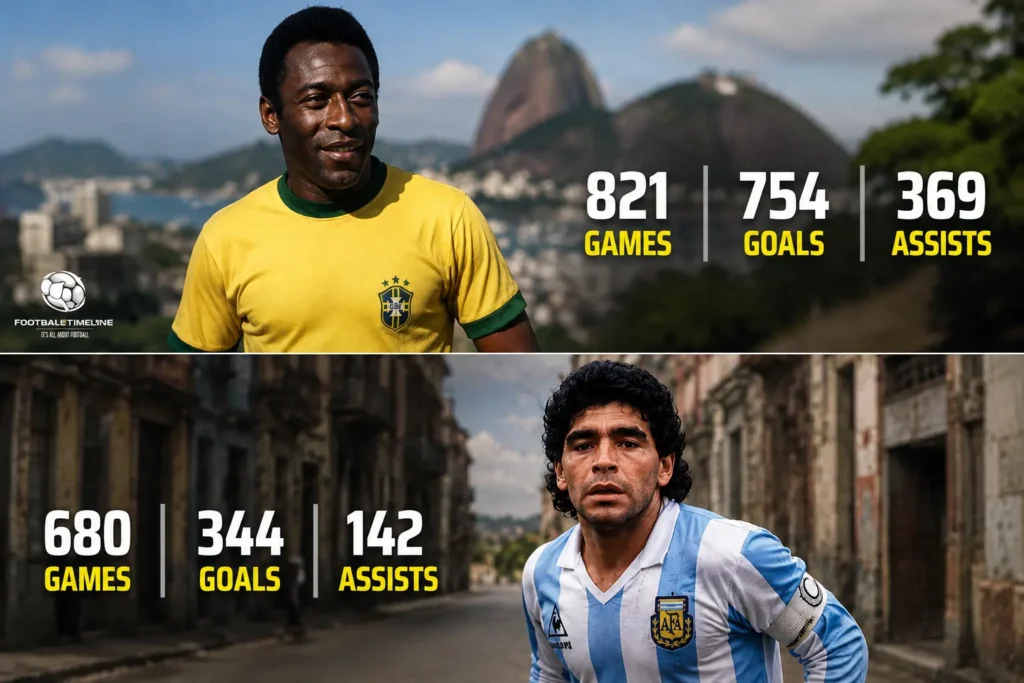
Despite decades of public debate comparing him to Diego Maradona, Pelé’s own assessment of the greatest player in history pointed elsewhere. He personally considered Alfredo Di Stéfano the more complete player, while consistently insisting that football success is a team achievement rather than an individual one — a rare note of humility from a man widely regarded as the game’s original GOAT.
Frequently Asked Questions
How did Pelé die?
Pelé died on December 29, 2022, at Albert Einstein Hospital in São Paulo, at age 82. The cause of death was linked to multiple organ failure following the progression of colon cancer, which he had been treated for since a tumor was first discovered in September 2021.
How many goals did Pelé score in his career?
Pelé’s career goal total is disputed due to inconsistent record-keeping. Guinness World Records credits him with 1,281 goals in 1,363 appearances across all senior and non-official matches, while other sources cite figures ranging from 757 official goals to as high as 1,303.
Why is Pelé called Pelé?
The exact origin of the nickname is unconfirmed. The most widely accepted theory is that it came from a childhood mispronunciation of “Bilé,” the name of a goalkeeper Pelé admired, which classmates turned into a taunt that eventually stuck.
How many World Cups did Pelé win?
Pelé won three World Cups with Brazil, in 1958, 1962, and 1970, making him the only player in history to achieve this feat. He played a limited role in 1962 due to injury but was central to Brazil’s titles in 1958 and 1970.
Why did Pelé join the New York Cosmos?
Pelé signed with the New York Cosmos of the NASL in 1975, turning down bigger offers from European clubs like Real Madrid and Barcelona. He wanted his children to grow up learning English and saw an opportunity to help introduce soccer to a broader American audience.
What is Pelé’s connection to the Michaelis dictionary?
In April 2023, Brazil’s Michaelis dictionary formally added “Pelé” as an adjective following a 125,000-signature campaign, allowing it to be used to describe excellence in any field, such as “the Pelé of basketball.”
Read About : kevin hart